Monday, 20 June 2011

Mencap blasts police for failing victims of disability hate crime

This article is published in today's Nottingham Post:
Mencap blasts police for failing victims of disability hate crime
A report which draws upon evidence submitted by Notts police and 13 other forces has concluded that officers are not doing enough to tackle disability hate crime.
The report published today by learning disability charity Mencap, entitled Don't Stand By, also draws on public opinion and suggests there is a general lack of police understanding of disability hate crime or a strategy to tackle it.
It cites the tragic deaths of Fiona Pilkington and Francecca Hardwick of Leicestershire in 2007 and David Askew of Greater Manchester in 2010 as two examples where low-level harassment ignored by police escalated into sustained abuse with fatal consequences.
Notts police have acknowledged the report's findings and today backed a new three-year campaign by Mencap against disability hate crime.
A police spokesman said: "We will be fully supporting the campaign, fully recognising that there are vulnerable people in the community who are victims of hate crime and that these incidents are not often reported to the police.
"We recognise this is not always easy for people so we have developed an easy-read leaflet and plan to work closely with our partners to ensure officers engage better with learning-disabled people.
"We also plan to work closely with partners including Mencap by reviewing hate incidents regularly together. We are providing our officers with more information and awareness about disability hate crime and we will continue to work hard to reassure victims that we take them seriously."
The Mencap report canvassed the opinion of a group of people with learning difficulties who had experienced a hate crime.
They reported that police officers were often rude and dismissive when they came to report hate crimes.
The report concluded that: "All participating police services claimed that the level of reported disability hate crime is much lower than that of actual disability hate crime, which is worrying as it means that police services cannot make properly informed decisions about effective resourcing."
Mencap chief executive, Mark Goldring, said: "It is estimated that as many as nine out of ten people with a learning disability are verbally harassed or exposed to violence.
"Today's report proves that police have not got to grips with disability hate crime, let alone crime against people with a learning disability. Early intervention is vital if people with disabilities are not to live in fear."
The launch of Mencap's three-year campaign against hate crime coincides with Learning Disability Week which started today.

Learning Disability Week

It's Learning Disability Week (Mon 20 - Sun 26 June). Mencap is promoting a campaign to end Learning Disability Hate Crime. To find out how you can join in, check out the website: www.mencap.org.uk/campaigns/learning-disability-week

Disabled people 'failed by police'

Today's Leicester Mercury carries an article of interest and importance to everyone concerned with the protection of vulnerable disabled people.
Disabled people 'failed by police'
Disabled people are being failed by the police and left to suffer violence, harassment and abuse, according to a report published today by Mencap.
The charity, which is also launching a three-year campaign against disability hate crime, said there was a "general lack of police understanding" of such crime, and no strategy to tackle it.
In its report, it cites the case of Fiona Pilkington, from Barwell, who killed herself and disabled daughter Francesca Hardwick in 2007, following 10 years of sustained abuse and harassment from yobs.

Read the full article, along with reader comments (and the chance to leave your own) on the Leicester Mercury website: http://www.thisisleicestershire.co.uk/Disabled-failed-police/story-12802300-detail/story.html

Saturday, 18 June 2011

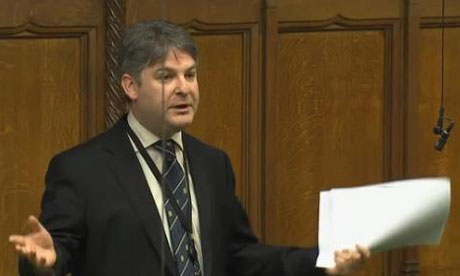
Tory MP Philip Davies: disabled people could work for less pay

From today's Guardian, reported by Allegra Stratton, Political Corresppondent:


Tory MP Philip Davies: disabled people could work for less pay
Shipley MP describes criticism of his remarks that disabled people could work for less than minimum wage as 'leftwing hysteria'
A Tory MP has sparked anger by suggesting that disabled people should work for less than the minimum wage to increase their chances of being taken on by employers.
Philip Davies told the Commons: "If an employer is looking at two candidates, one who has got disabilities and one who hasn't, and they have got to pay them both the same rate, I invite you to guess which one the employer is more likely to take on.

Read the full article, along with reader comments (and the chance to leave your own) on the Guardian website: http://www.guardian.co.uk/society/2011/jun/17/tory-philip-davies-disabled-people-work

School's ban on boy's cornrows is 'indirect racial discrimination'

Article by Matthew Taylor in today's Guardian.


School's ban on boy's cornrows is 'indirect racial discrimination'
High court rules against London secondary school after boy was refused entry for breaching ban on 'gang-related' hairstyles
An 11-year-old boy who was turned away on his first day at secondary school for wearing his hair in cornrows, has won his case at the high court after a judge ruled the school's policy resulted in "indirect racial discrimination".

Read the full article, along with reader comments (and the chance to leave your own) on the Guardian website: http://www.guardian.co.uk/uk/2011/jun/17/school-ban-cornrows-indirect-discrimination

Tuesday, 14 June 2011

Core Reference Group meeting

It's the regular bimonthly meeting of the Core Reference Group of the Regional and Equality Diversity Partnership (REDP). We're meeting at Leicestershire Centre for Integrated Living (LCIL) this afternoon - and as well as our hosts (representing disabled people), the meeting includes representatives of organisations working in the protected characteristics of faith or belief, older people, race and sexual orientation. There's a smaller torunout today than we've been used to at previous meetings; many of our regular attendees are caught up in tortuous negotiations with funders at the moment.

The following items are on our agenda this afternoon:

cuts in funding and support for equality-focused groups in East Midlands
our collective response to the Coalition's consultation on reforming the Equality and Human Rights Commission
our response to the Coalition's Red Tape Challenge to the Equality Act 2010
planning our conference: "Equality Act 2010 and its Duties" in Nottingham, 30 June
our current and future relations with English Regions Equalities Network

At the end of this month, REDP comes to the end of the second year of our initial three-year funding. We've been talking for several months now about how to make the partnership sustainable and a number of irons are in the fire. it struck me today, while discussing our plans for the next 12 months that our project could be described in the format of a three-act summer action-adventure movie (with each act akin to a year of our funding):

Act 1: You're given your mission
Act 2: Assemble and train your team for the mission
Act 3: Carry out your mission

Doesn't sound like much of a movie, perhaps, but I'm sure the bare bones are recognisable. In Act 3, REDP has to make its big impact. Our name has to be seen all over the place - and has to be associated with strong, positive outcomes. I've been put in charge of REDP's social media and am looking forward to using that to advance our cause.

Wednesday, 25 May 2011

New questions over big society as tsar leaves post after a year

Following the Guardian's coverage of the latest relaunch of the Prime Minister's "Big Society" at the start of this week (see blog post Monday 23 May), it carries this news today.

New questions over big society as tsar leaves post after a year
Cabinet office insists departure does not mark scaling back of project, but Labour say flagship policy is descending into farce
By Polly Curtis, Whitehall correspondent
Lord Wei, the man parachuted into the House of Lords to lead the government's "big society" project, is to leave his post after less than a year.
Wei, dubbed the big society tsar, is leaving to work for a charity. The Cabinet Office has scrapped his role and the Downing Street policy unit will now take responsibility for the programme.
A Cabinet Office spokesman insisted that it did not mark a scaling back of the prime minister's ambitions for the big society, saying that Wei had completed the work of developing the policy so there is no need to replace him.
The news came just a day after David Cameron gave a major speech on the subject in what was widely interpreted as his fourth relaunch of the project, which has struggled to register with the public and faced cynicism from Tory backbenchers.
Cameron thanked the peer for his "hard work" while Wei said he was glad to have played a "modest" role in the project.
Labour said the flagship policy was descending into a "farce" with no one in government now responsible for it.
Wei said in February that he was scaling back his hours to spend more time with his family and earn more money. His statement caused widespread comment about the practicality of a policy that relied, in part, on the development of a volunteering culture that could clash with the realities of people's everyday working lives.
It also emerged that when Wei was asked to do the job, only at the last minute did he find out the post was unpaid.
He also had to drop his work with other charities to avoid a conflict of interest. It is understood that the government was unable to offer him a paid adviser post as it was attempting to reduce the number of such appointments.
He was given a Tory peerage – making him Lord Wei of Shoreditch – and a desk in the Cabinet Office as the "big society tsar".
Nat Wei, 34, is a former management consultant who has no private income to fall back on. He worked for Ark, one of the biggest sponsors of academies, before setting up the Shaftesbury Partnership, a social entrepreneurial company.
He will now go to work Community Foundation Network, charity that promotes "community philanthropy".
Cameron said in a statement: "Nat has worked incredibly hard over two years to help develop policies that support the big society.
"He has played an important role in delivering key initiatives like community organisers, national citizen service and the big society bank. I wish him every success in his new role with the Community Foundation Network."
Wei said: "I will always be proud to have played a modest role in helping lay the foundations here on which the big society will be built in years to come.
"I want to thank everyone, but particularly the prime minister, for giving me this opportunity and for pursuing this vision with courage and determination.
"I look forward to helping in my own small way outside government – because it is out there, in local communities, that the heavy lifting must now be done."
Tessa Jowell, shadow minister for the Cabinet Office, said: "No doubt everyone will wish Nat Wei well, but yet again the big society is descending into farce.
"Only a day after Cameron told us all to take more responsibility, it appears that there will now be nobody in his government responsible for bringing the big society into reality."

Tuesday, 24 May 2011

Cameron defends the "big society"

This is from The Guardian's Professional Local Government Network online service.
Cameron defends the "big society"
By Kate Hodge, Guardian Professional
David Cameron has defended his idea of the "big society" amid continued criticism. Speaking as the government published its Giving White Paper, Cameron claimed that big society was not just a money saving exercise, but a strong commitment to empowering communities. He also unveiled plans to give £40m to the third sector, including £30 million to help volunteer organisations and a £10m social action fund. Many welcomed plans to introduce tax incentives to promote charitable donation. Others, however, claimed the schemes were a desperate attempt by the government to help charities struggling to cope with the effects of strict economic austerity. Rachael Maskell, Unite's national officer, said, "Unless the White Paper addresses the funding crisis in a more strategic way and also the massive job losses already affecting charities, the White Paper will be no more than a white elephant."

Stand by for Big Society 4.0

Here's Michael White, writing in today's Guardian about the latest relaunch of David Cameron's "Big Society".
Stand by for Big Society 4.0
David Cameron's 'big society' strategy: if it it ain't working – relaunch it
By Michael White
The cerebral French have a saying about public policy. "It will work in practice, but will it work in theory?" David Cameron has the more familiar problem with his "big society" concept. Will it work in practice at a time when economic hardship is already putting pressure on voters' spare time and charitable impulses?
But he's also got the French problem. Even as a campaign slogan in 2010 it felt more like a fluffy add-on devised by his biking strategy guru, Steve Hilton, than something that would make people go, "Gosh, y'know, he's right", and sign on to help the Samaritans on a Saturday night.
Hence yesterday's relaunch, the fourth on most reckonings. As part of the Tory detox, Dave launched Big Society 1.0 well before polling day. Tory MPs were sniffy, but he persevered to show who was boss. Besides, his Witney constituency is so affluent it could almost work there. Liverpool, where he relaunched Big Society 2.0 with writer Phil Redmond, a year later, is a tougher call.
But Dave's a fast learner, and in February he had another try at grandiose Somerset House on the Thames. Inappropriate or what? It looks like a palace but is actually the first purpose-built civil-service building in England – the embodiment of the Georgian Big State and stuffed with quill-pen pushers.
Although he wheeled on a billionaire to write a charity cheque, the Daily Mirror dubbed Big Society 3.0 a "big con" in which hardly any Tory MPs were doing voluntary work. Undeterred, he rolled out Big Society 4.0, complete with its own white paper and the idea of using cash machines to solicit donations. But it's not all about money. Got that?

Read this article, along with reader comments (and the opportunity to make your own) on the Guardian website: http://www.guardian.co.uk/politics/2011/may/23/stand-by-big-society?INTCMP=SRCH

Saturday, 21 May 2011

Big Society in The New York Times

In her Guardian article (Saturday 21 May), reproduced in this blog earlier today, Polly Toynbee refers to a piece by David Brooks, author of The Social animal, about David Cameron's "Big Society" published in The New York Times. Here is that article (from the edition of Thursday 19 May).

It's intersting to consider how people from outside the UK see what's happening here, isn't it? There's considerable cross-fertilisation between the kinds of social, political and economic reform we're seeing in the UK and in the US. Normally it's seen that we're seen as the one lagging behind; is that what this article says?

The Big Society
By David Brooks
Fifty years ago, Jane Jacobs published a book called The Death and Life of Great American Cities. The book was not only an indictment of contemporary urban development; it offered a vision for a healthy community. Jacobs described a streetscape as an organic ballet, as the comings and goings of shop owners, office workers, cops and parents. She described the complex interplay of many different types of people on one city block.
Here in Britain, Prime Minister David Cameron’s government is trying to foster that sort of society. Until Cameron, Britain — like the U.S. — had one party that spoke on behalf of the market (the Conservatives) and one party that spoke on behalf of the state (Labour). But Cameron is initiating a series of policies, under the rubric “Big Society,” that seek to nurture community bonds, civic activism and social capital.
The Big Society started in part as a political gadget, as a way to distinguish the current Conservatives from the more individualistic ethos of the Thatcher years. It has turned out to be something of a damp squib politically. Most voters have no idea what the phrase “Big Society” means. But, substantively, the legislative package has been a success. The British government is undergoing a fundamental transformation.
Cameron inherited one of the largest governments in the affluent world (under Gordon Brown, the public spending reached 51 percent of G.D.P.). It was also one of the most centralized. The national government accounts for 70 percent of total government spending in Britain, compared with 55 percent in the U.S., 35 percent in Japan and 20 percent in Germany.
Cameron has unveiled a series of measures to decentralize power to local governments, to increase government transparency and to disburse welfare provisions to a variety of delivery mechanisms.
His government has boosted the number of charter schools. There’s been a welfare reform bill to encourage work and to get rid of the perverse incentives that induced people to remain on the dole. The police forces are going to have to start answering to the public. Twelve more big cities will have now elected mayors. Local communities have more control of federal money and run things themselves. There’s been a raft of provisions trying to use the insights from behavioral economics.
Cameron’s trying to get the British people to change their social norms. Many British governments have effectively said: If you pay your taxes you can sit back and we experts will take care of your problems. The Thatcher government said: Get off your couch and start a business. Cameron says: Get off the couch and take responsibility for your community. Cameron is trying to spark active citizenship.
The measures are not without critics. From the left, Polly Toynbee, a columnist for The Guardian, argues that the current centralized system ensures uniformity and fairness. But with localism and decentralization, she continues, the richer areas will outperform the poorer areas. Inequality and corruption will replace fairness and uniformity.
Others see the Big Society as the gentle mask to cover savage spending cuts. Still others see it as upper-middle-class noblesse oblige. Working-class families who have two jobs and who come home exhausted at 10 in the evening don’t need to be lectured by the government on why they should volunteer at the blood bank.
There’s some truth to those critiques. But the Big Society programs still have the potential to produce enormous benefits for Britain.
The people who thrive in a globalized information economy have the ability to process complex waves of information. They have the ability to navigate incredibly diverse social environments.
Where do people learn these skills? They learn them when they grow up in and are nurtured by rich social networks. They learn them when they live within vibrant institutions that pass down practices and habits. They learn them when they live in areas of high social trust, where people are able to reach out and work together.
By decentralizing power, and inciting local energies, Cameron’s reforms are fostering the sorts of environments where human capital grows.
Cameron still has to fight for these programs, especially against the bureaucracy’s bias for uniformity and control. And the big shortcoming is that the Big Society skirts commercial life. If centralized government weakens community networks, then concentrated corporate power weakens the networks of entrepreneurs and tradesmen.
As the scholars at the think tank ResPublica have pointed out, big corporations use the complex tax code, dense regulations and state contracting rules to stifle small-business competition. Jane Jacob’s vibrant sidewalks didn’t only benefit from flourishing community groups, they benefitted from skilled workers linking together to share capital and work. The Big Society needs to connect with economic aspirations and broadly shared prosperity.
But, even so, Cameron is doing something interesting. No other government is trying so hard to tie public policy to the latest research into how we learn and grow.

Read this article on the website of The New York Times: http://www.nytimes.com/2011/05/20/opinion/20brooks.html?_r=1&ref=columnists